Understanding rental property cash flow starts with a question that rent totals alone cannot answer: after the property's bills and mortgage payments, how much money is actually left, and what still needs to be funded?
For a Winnipeg landlord, a bank deposit from a property manager is only one part of that picture. Some expenses may be paid directly by you, some money may be retained for upcoming work, and a payment received this month may relate to an earlier rental period. A useful monthly review connects all of those details.
At Canopy mgmt, we believe owners should be able to understand the numbers behind their rental. This guide walks through seven checks, a worked example and a repeatable month-end routine. The goal is to make your statement easier to read and your next decision better informed.
1. Start your rental property cash flow review with rent collected
Begin with the rent ledger, rather than the advertised rent or the amount you hoped to collect. Compare rent charged for the month with payments received, any outstanding balance, and payments that relate to another period. Keep each unit visible if you own a duplex or a small apartment building.
For example, a tenant's payment of an overdue amount can make the current month's deposits look unusually strong. It improves cash available today, but it does not mean the property's normal monthly earning capacity has increased. Likewise, a charge on a ledger does not put money in the bank until it is collected.
Record the date, amount and rental period for each payment. Keep owner contributions and loan proceeds on separate lines so they do not appear to be rent. If you move money between your own property accounts, identify the transfer instead of counting the same receipt twice.
This distinction also matters when you compare your cash review with tax records. The CRA's rental-income accounting guidance says the accrual method is used in most cases, with cash-method use limited to qualifying circumstances. Reviewing money received and paid each month does not, by itself, determine the accounting method for your tax return.
2. Separate operating costs from mortgage payments
Group the recurring costs of running the property: property taxes, insurance, landlord-paid utilities, routine maintenance, management fees, and other applicable services. Include costs you pay personally as well as charges shown on your manager's statement. Our guide to rental property ownership costs provides a broader starting list.
Then show financing separately. Net operating income, or NOI, measures property income less operating expenses before financing and income taxes. Rental property cash flow after debt service takes the next step by accounting for mortgage payments. A property can have a positive operating result and still need an owner contribution after financing.
Check for double counting. If your mortgage withdrawal includes a property-tax collection amount, reconcile that component with your tax budget. Do not subtract the same tax amount once as an operating cost and again inside a combined mortgage-and-tax payment.
For a quick monthly comparison, use consistent categories and keep a note explaining unusual items. A large plumbing invoice should be identifiable, rather than disappearing into an unexplained increase in a general expense total.
3. Include the full mortgage payment in the cash calculation
A mortgage payment usually contains interest and principal. Both reduce the cash in your account, even though they have different accounting and tax treatment. Leaving principal out of your rental property cash flow calculation can overstate the money available for other bills.
The CRA states that mortgage principal repayments are not deductible rental expenses. That does not make principal a cash inflow: it remains money you have paid out. Keep the cash calculation and the tax calculation distinct, and have your accountant confirm the treatment of your financing.
Also verify which account makes the payment. If your manager sends you an owner distribution and you then pay the mortgage from your own account, the distribution is not your final after-mortgage result. Add that owner-paid mortgage payment to the review.
When financing changes, update the budget with the lender's actual payment amount and effective date. Comparing a new statement against an old mortgage assumption can make an otherwise understandable difference look like a management or rent-collection problem.
4. Give reserves and major replacements their own lines
A month without a repair invoice is not necessarily a month without future repair costs. A roof, furnace or appliance can be approaching replacement even while day-to-day operating expenses look modest. Your rental property cash flow review should show how you are preparing for that work.
Build the reserve plan from the property's condition, known work, available quotes and the timing of upcoming costs. An older furnace and a recently replaced furnace do not call for identical assumptions. Choose amounts that reflect the building rather than treating a generic percentage as a guarantee.
Keep three things separate: money set aside, money actually spent, and money transferred to you. Moving funds into a savings account you own reduces the amount available for distribution, but does not make those funds disappear from your total cash holdings.
When you later pay a replacement invoice from that reserve, record the actual payment and the reserve draw. Avoid subtracting both an allocation and the same funded expense when measuring the period's total cash change. Let your accountant determine whether work is a current expense or a capital item for tax purposes.
5. Reconcile the owner payout with the statement
An owner distribution is the amount transferred to you under your management arrangement. It may differ from this month's rental property cash flow because of an opening balance, retained funds, unpaid invoices, timing or expenses paid outside the management account.
Ask for a simple bridge between the two. Start with the opening cash balance, add receipts, subtract payments, and identify the closing balance, owner distribution and any funds retained. Make sure each line relates to the same account and reporting period.
- Match the statement's owner distribution to the deposit in your bank account.
- Identify which bills the manager paid and which bills you paid directly.
- Check whether an invoice is paid, approved but unpaid, or still being reviewed.
- Ask why any retained amount changed and what it is intended to cover.
- Keep supporting invoices and payment references with the monthly records.
If a number does not reconcile, ask for its transaction history before changing the budget. A timing difference needs a different response from a recurring operating shortfall. Clear records let you address the actual cause.
6. Compare monthly rental property cash flow with the annual plan
One month is useful for spotting missing payments; it is less useful for judging an entire rental investment. In Winnipeg, snow clearing, heating where paid by the landlord, seasonal maintenance and turnover work can land unevenly through the year. Review the year-to-date totals alongside the monthly result.
Separate an actual cash report from a planning budget. The report shows receipts and payments that happened. The budget can spread an annual insurance bill over twelve months to show its monthly funding requirement. Both views are useful, but they answer different questions.
For planning, test a vacancy period, an upcoming repair and the next known mortgage payment change. Use property-specific assumptions and label them. Do not subtract a budgeted vacancy allowance from rent that is already reduced for an actual vacancy when you reconcile the same period's cash.
Track actual results against the plan and write a short explanation for material differences. An annual review becomes much easier when you already know which months contained a replacement, a late payment or a one-time leasing cost.
7. Use the numbers to choose the next action
A rental property cash flow review should end with a decision or a clear confirmation that the plan is on track. If the shortfall comes from an owner-paid bill missing from the budget, correct the budget. If rent remains unpaid, ask for a documented collection update. If planned work is unfunded, arrange the funding before approving a discretionary withdrawal.
Avoid responding to a weak month by postponing necessary maintenance without assessing the consequences. Instead, separate urgent work, routine service and optional improvements. Request a clear scope and cost before deciding how to schedule non-urgent projects.
When reviewing management costs, compare the complete service arrangement. Consider recurring fees, applicable leasing and renewal charges, work coordination and the reporting you receive. Canopy's current property management packages and pricing outline our service options, including an income and expense tracker.
Write down the issue, the person responsible for following up and a target date. This turns a concern such as “the payout seems low” into a question that can actually be resolved.
A simple rental property cash flow example
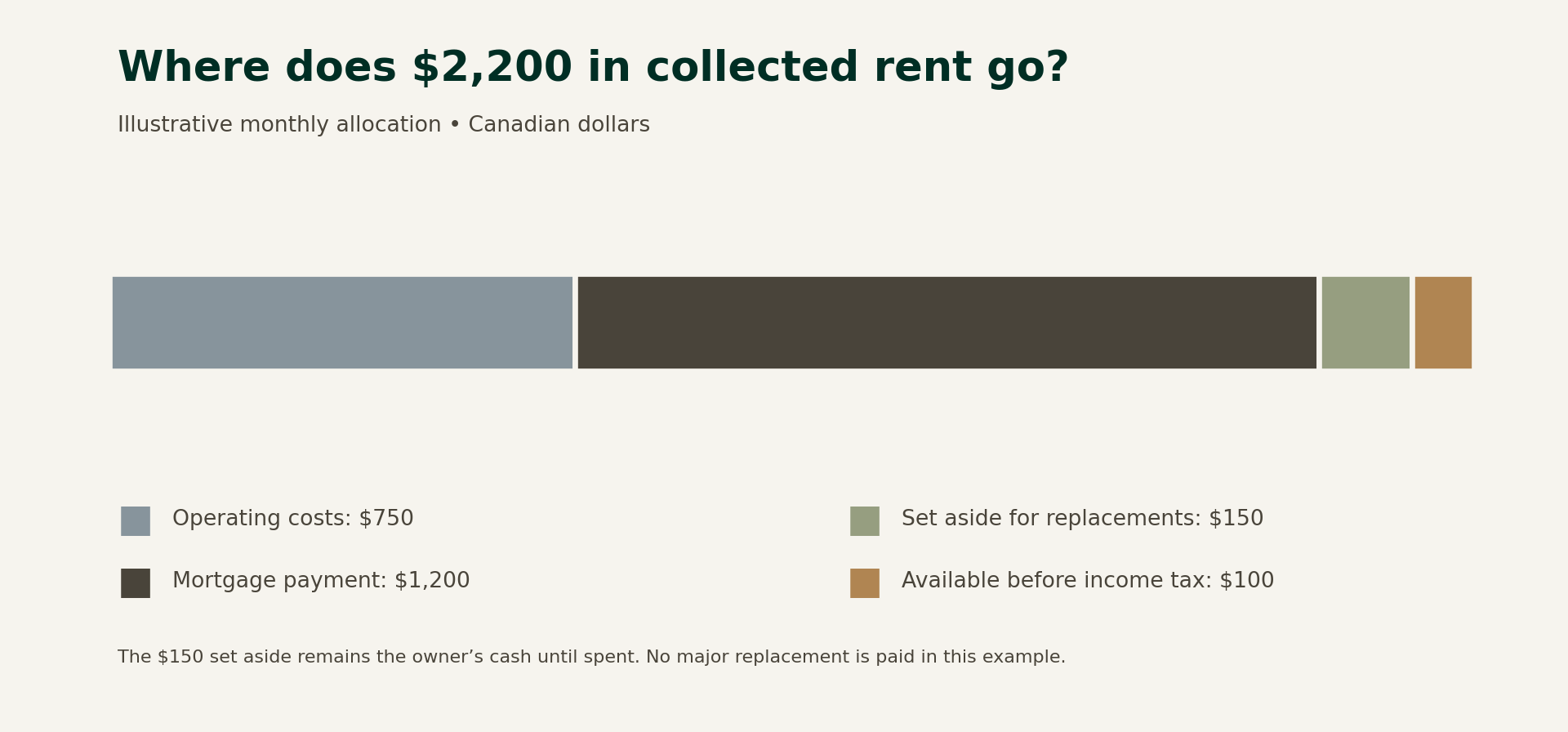
The figures below are an invented teaching example in Canadian dollars, not Winnipeg rent estimates, Canopy pricing or a forecast. Assume the rent is collected, all listed bills are paid in the same month, no opening balance is carried forward, and no major replacement occurs.
| Monthly item | Illustrative amount |
|---|---|
| Rent collected | $2,200 |
| Property taxes | −$250 |
| Insurance | −$110 |
| Landlord-paid utilities | −$70 |
| Routine repairs and maintenance | −$120 |
| Management cost, including any applicable tax | −$200 |
| Operating cash surplus before financing | $1,450 |
| Mortgage principal and interest | −$1,200 |
| Cash after operating costs and mortgage | $250 |
| Amount earmarked for future replacements | −$150 |
| Amount available before income tax and owner withdrawals | $100 |
Here, $2,200 of rent does not mean $2,200 is available to the owner. The property produces $250 after the listed operating costs and mortgage. Setting aside $150 leaves $100 uncommitted before income tax. The reserve transfer changes how that $250 is allocated, rather than creating an additional third-party expense.
Now assume a separate $600 repair is paid from the operating account in that same month. Cash after operating costs and mortgage falls from $250 to negative $350. Funding that payment from an existing reserve may avoid a new owner contribution, but the property still incurred a cash outflow and has a smaller reserve.
These two views explain why rental property cash flow, a manager's payout and your bank balance can differ without any of them being a calculation error. The important step is to identify each payment and transfer once.
How an opening balance changes the payout
For a separate reconciliation using the same monthly income and costs, suppose the management account starts with $300, receives $2,200, pays the $750 of operating costs and retains $150. It could distribute $1,600: $300 + $2,200 − $750 − $150. If you then pay the $1,200 mortgage yourself, $400 remains from that distribution.
The month's rental property cash flow after operating costs and mortgage is still $250. The extra $150 available through the payout comes from releasing part of the opening balance. Checking the opening and closing balances prevents that release from being mistaken for improved monthly performance.
Make your monthly review repeatable
Use one folder per month and keep the statement, rent ledger, invoices, mortgage details and owner-paid receipts together. Compare the same figures each time: rent collected, operating payments, debt service, major spending, retained funds and owner distributions.
Review unresolved items again the following month. If an invoice was approved but unpaid, confirm when it was paid. If an overdue tenant balance cleared, identify the period it covered. If a reserve was used, decide whether the future funding plan needs to change.
This routine makes rental property cash flow easier to understand without reducing a building to a single headline number. It also gives your accountant a clearer set of records for year-end work.
Get a clearer view of your Winnipeg rental
If you want help connecting rent collection, maintenance coordination and understandable property records, start with your latest statement and a list of the expenses you pay directly. Those documents make a conversation about management more useful.
At Canopy mgmt, we provide Winnipeg property management services. We can explain our service options and discuss the information needed to assess your property's management needs. Contact our team to talk through your next steps.
This guide explains a monthly cash-review process. Examples exclude personal income-tax calculations; confirm property-specific accounting and tax treatment with your accountant. CRA sources checked November 17, 2026.