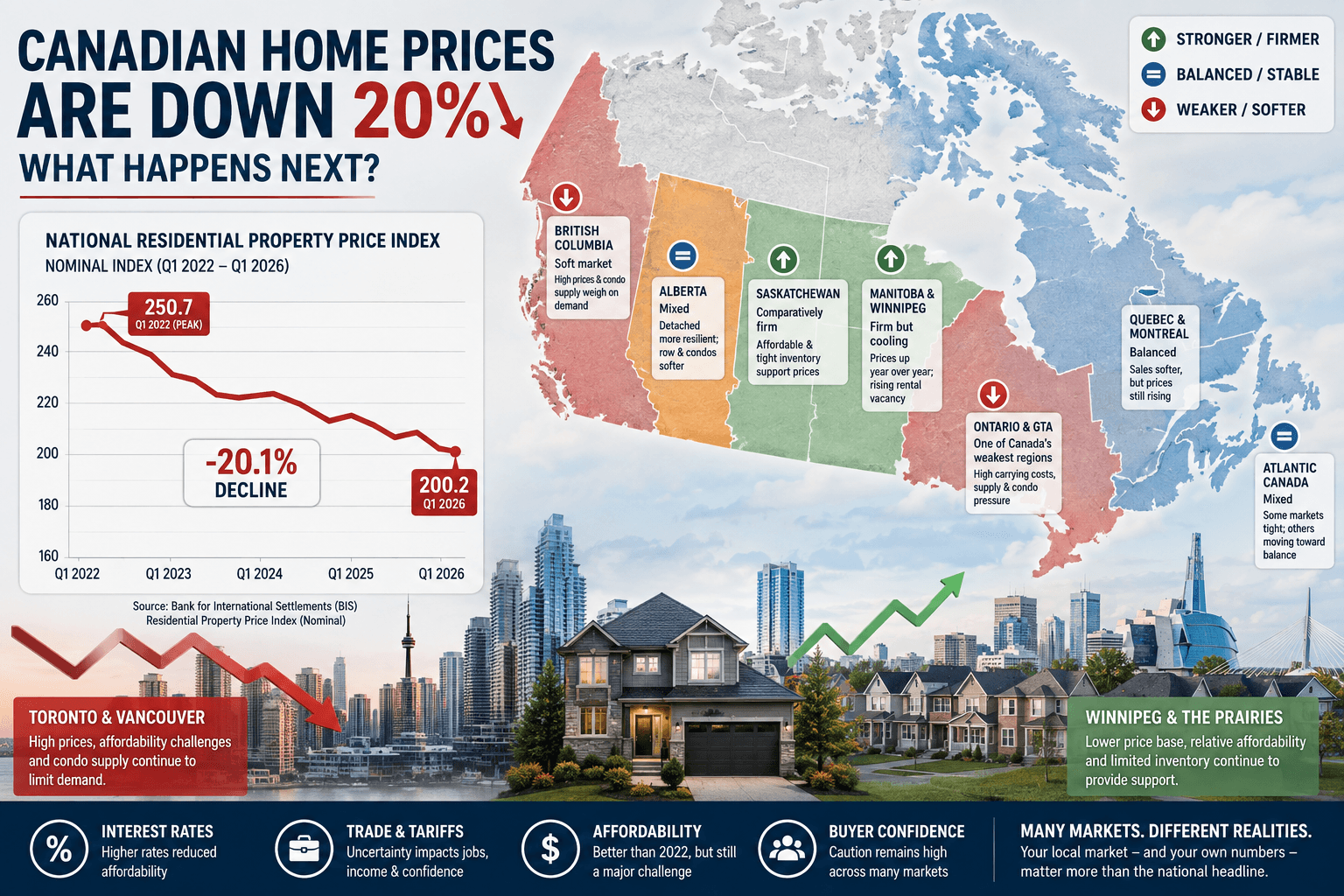
A national measure of Canadian Housing Market has already experienced the type of decline that many homeowners fear.
According to the Bank for International Settlements residential property price index, Canadian residential prices peaked at an index level of 250.7 in the first quarter of 2022. By the first quarter of 2026, that index had fallen to 200.2—a nominal decline of approximately 20.1%.
After adjusting for inflation, the decline is even larger. The BIS real residential property price index fell by approximately 29.3% over the same period.
That does not mean every Canadian home has lost 20% of its value. It also does not mean another 20% decline is inevitable.
Canada is experiencing several housing markets at once. Ontario and British Columbia have faced substantial price and sales pressure, particularly in expensive urban and condominium markets. Manitoba, Saskatchewan, parts of Alberta, Quebec and some Atlantic markets have followed very different paths.
The important question is no longer simply whether Canada home prices have fallen. It is what the correction means for homeowners, prospective buyers, tentative sellers, landlords and real estate investors—and whether the country is experiencing a housing-market crash or a difficult regional adjustment.
Have Canadian home prices really fallen 20%?
Yes—but the measurement needs context.
The BIS data measure the national residential property market through an index. They do not represent a single average house, city or property type.
| National price measure | Q1 2022 | Q1 2026 | Approximate change |
|---|---|---|---|
| Nominal residential price index | 250.7 | 200.2 | -20.1% |
| Inflation-adjusted price index | 198.6 | 140.4 | -29.3% |
Nominal prices reflect the dollar value of housing at the time of sale. Real prices account for inflation and measure how much purchasing power the property retains.
This distinction matters. A home that sells for the same amount as it did several years earlier has not experienced a nominal loss, but it may still have lost considerable value after inflation.
National averages can also be distorted by the mix of homes sold. If more expensive homes change hands during a particular month, the average sale price can rise even when the value of a typical home is declining.
That occurred in July 2026. The national average sale price was 0.2% higher than a year earlier, while the MLS Home Price Index—which is intended to track changes in a typical property—was 3.3% lower. The HPI nevertheless edged up 0.1% from June, suggesting that the national market may be moving toward stabilization after a prolonged correction.
A national figure should therefore be treated as economic context, not as an appraisal of an individual property.
Housing Market Canada: Crash or Regional Correction?
There is no universally accepted percentage that automatically turns a housing correction into a crash.
A crash usually involves more than falling prices. It is typically associated with widespread forced selling, rapidly rising mortgage defaults, severe credit restrictions, sharply increasing unemployment and price declines across most regions and property types.
Canada has pockets of serious stress, but the evidence does not currently point to a uniform national collapse.
In July 2026, Canada’s national sales-to-new-listings ratio was 51.3%, within the range generally considered a balanced market. There were 4.7 months of inventory nationally, also close to the long-term average. Ontario had moved away from the buyer-market conditions experienced earlier in the year, while several formerly strong seller’s markets were becoming more balanced.
The Bank of Canada’s 2026 Financial Stability Report found that the financial system continued to function well despite U.S. tariffs and trade uncertainty. It identified elevated household debt and pockets of financial stress, but also found that Canadian banks remained well positioned to absorb economic shocks.
The most accurate description is therefore a significant national correction with sharply different regional outcomes.
For a condominium investor in Toronto, conditions may feel close to a crash. For an owner of an entry-level detached home in Winnipeg or Regina, the market may still favour sellers. Both experiences can exist at the same time.
Why Canada Home Prices Fell
1. Bank of Canada interest rates changed affordability
Canada’s housing correction began as borrowing costs rose at extraordinary speed.
The Bank of Canada’s policy rate was only 0.25% in January 2022. It reached 5% by July 2023 before eventually falling to 2.25% by July 2026.
Lower policy rates have provided some relief, particularly for variable-rate borrowers. However, Canada mortgage rates have not returned to their pandemic-era lows, and many households are renewing mortgages at higher rates than they originally received.
A lower purchase price does not necessarily create an affordable monthly payment when the mortgage rate, property taxes, insurance, utilities and maintenance costs are all elevated.
Fixed mortgage rates also do not move perfectly with the Bank of Canada’s overnight rate. They are influenced by bond-market expectations, lender funding costs and risk. As a result, a Bank of Canada interest rates cut does not guarantee an equivalent reduction in a buyer’s five-year fixed mortgage.
2. U.S. trade and tariff uncertainty affect housing
Tariffs influence the housing market indirectly through employment, income, inflation and confidence.
Canada’s trade relationship with the United States remains one of the Bank of Canada’s most important economic risks. Although most North American trade remains tariff-free, some industries have been heavily affected by sector-specific measures.
A household may technically qualify for a mortgage but delay buying because of uncertainty about employment. A business owner may postpone purchasing a larger home because future revenue is unclear. An investor may require a higher return before accepting the risks of another property.
Trade disruptions can also raise the cost of construction materials and consumer goods. If tariff-related inflation persists, the Bank of Canada may have less room to reduce interest rates.
The effect can therefore move in both directions: trade weakness may reduce housing demand, while tariff-related inflation may keep borrowing costs higher than buyers expect.
3. Affordability improved—but not enough
Lower prices have improved some affordability measures, but Canadian housing market remains expensive relative to household income.
In its Summer 2026 Housing Market Outlook, CMHC said high mortgage rates, slow income growth, weaker population growth and economic uncertainty were keeping buyers cautious. Improved affordability alone had not been enough to bring many households back into the market.
This creates a slow adjustment rather than an immediate collapse.
Buyers wait for better prices or lower rates. Sellers resist accepting less than neighbouring homes received several years ago. Sales volumes weaken, listings accumulate in some markets and prices gradually move toward what buyers can finance.
Property type matters as well. Expensive condominium markets with substantial new supply can decline while entry-level detached homes remain competitive. That is one reason a national housing headline may not describe the property down the street.
A Regional View of the Canadian Housing Market
CMHC expects Prairie markets to lead price growth, Quebec to post more modest gains, and British Columbia and Ontario to remain comparatively weak because of affordability constraints, slower population growth and greater supply.
| Region | General market direction | Main consideration |
| British Columbia and the Lower Mainland | Soft to balanced | High prices, affordability constraints and condominium supply continue to limit demand. |
| Alberta and Calgary | Mixed | Detached and semi-detached properties have been more resilient, while Calgary row-home and apartment segments have experienced greater pressure. |
| Saskatchewan | Comparatively firm | Relative affordability and limited inventory continue to support prices in several communities. |
| Manitoba and Winnipeg | Firm but gradually cooling | Prices remain positive year over year, although sales have slowed and rental vacancy is rising. |
| Ontario and the Greater Toronto Area | One of Canada’s weakest regions | High carrying costs, greater supply and condominium-market pressure continue to weigh on prices. |
| Quebec and Montreal | Balanced with positive price growth | Sales have softened, but prices have continued to rise in several property categories. |
| Atlantic Canada | Mixed | New Brunswick and Newfoundland and Labrador remain relatively tight, while other markets are moving closer to balance. |
Recent regional reporting illustrates the differences. In July 2026, the GTA composite benchmark price was down 4.6% from a year earlier. In Calgary, detached prices were down only modestly, while row-home prices were down more substantially. Montreal sales declined, yet prices remained higher across its principal property categories.
Why Winnipeg May Not Follow Toronto and Vancouver
Winnipeg entered the correction with a much lower price base than Toronto or Vancouver. That relative affordability gives the local market a larger pool of potential buyers and reduces the size of the mortgage needed to purchase a comparable home.
Manitoba’s overall MLS benchmark price was $392,900 in July 2026, up 3.2% from July 2025. Single-family, townhouse and apartment benchmark prices all remained higher year over year. Inventory had increased, but the province still had only 2.2 months of supply—below its long-term July average.
CMHC’s Winnipeg housing market forecast also differs from its outlook for many Ontario and British Columbia markets. It projected an average Winnipeg resale price of approximately $423,866 for 2026, compared with $414,558 in 2025. At the same time, forecast sales were lower and the rental vacancy rate was expected to rise from 2.9% to 4.4%.
This does not mean Winnipeg housing market is immune from a Canadian housing market downturn.
A weaker economy, job losses, higher mortgage rates or prolonged trade disruption could still reduce local demand. Rising vacancy also means landlords cannot assume that every property will rent immediately at any asking price.
The more accurate interpretation is that Winnipeg’s resale market has remained comparatively firm while its rental market becomes more competitive.
For a deeper local analysis, see Canopy’s guide to the Winnipeg real estate market for investors. Landlords should also review how Canadian rent prices are adjusting before setting rents or forecasting future income.
What the Correction Means for You
For Canadian homeowners
A national decline does not become a realized loss unless the property is sold.
An owner who bought before the pandemic may still have substantial equity, even if their home is worth less than it was at the 2022 peak. An owner who purchased near that peak with a small down payment may have much less flexibility.
Homeowners should focus on:
- Their current mortgage balance and renewal date
- A realistic local valuation based on recent comparable sales
- The monthly payment at renewal
- The amount of equity remaining after selling costs
- How long they expect to remain in the property
Owners concerned about renewal payments should speak with their lender or mortgage professional before the renewal deadline. Waiting until payments are already missed can reduce the available options.
For prospective homebuyers
A more balanced market can give buyers something they lacked during the pandemic-era boom: time.
Buyers may be able to include financing and inspection conditions, compare multiple properties and negotiate repairs or price. However, a lower price is only helpful if the full monthly cost is affordable.
Rather than trying to predict the exact bottom, buyers should ask whether they can comfortably own the property for several years under realistic assumptions.
That means accounting for mortgage payments, taxes, insurance, utilities, condominium fees, repairs and possible income interruptions. Condominium buyers should also review reserve-fund documents and the possibility of future special assessments.
For tentative sellers
Sellers should avoid anchoring their expectations to a neighbour’s 2022 sale.
The relevant value is what comparable properties are selling for now. An overpriced listing can remain unsold even when the broader market is technically balanced or favourable to sellers.
Owners who do not receive an acceptable offer may consider renting the property instead, but that decision should be based on a complete calculation.
Compare the expected proceeds from selling with the property’s likely net rental income after mortgage payments, property taxes, insurance, vacancy, repairs, capital improvements and management. Tax consequences should also be reviewed with a qualified accountant.
The decision is not simply whether the monthly rent covers the mortgage.
For landlords and real estate investors
Falling purchase prices can create opportunities, but only when the rental income supports the property’s full cost.
Investors should stress-test vacancy, mortgage renewal, maintenance, tenant turnover and major repairs. A property that produces a small surplus under perfect conditions may become cash-flow negative after one vacancy or an unexpected furnace replacement.
Property type is also important. Smaller multi-unit properties may provide more than one source of rent, but they introduce additional maintenance, financing and management considerations. Canopy’s guide to missing-middle housing in Canada explores duplex, triplex and fourplex opportunities in greater detail.
Investors can also follow Canopy’s broader housing-market analysis for updates affecting Winnipeg property owners.
For renters
Easing rental markets can give tenants more choice and negotiating power, particularly where new apartments and investor-owned condominiums have increased supply.
However, national rent trends should not be treated as a guarantee that every Winnipeg neighbourhood or property type will become less expensive. Well-maintained homes in desirable areas may continue to command strong rents even as vacancy rises across the broader market.
Could Canadian Housing Market Prices Fall Another 20%?
Another 20% national nominal decline is possible, but it is not the baseline outlook presented by Canada’s major housing and financial institutions.
Such a decline would likely require several problems to occur together: a sharp rise in unemployment, widespread forced selling, tighter mortgage credit, renewed inflation and interest-rate pressure, or a prolonged trade shock that materially reduces household income.
CMHC’s baseline outlook instead anticipates continued price weakness through 2026 followed by modest improvement in 2027 and 2028. CREA’s July data also showed prices stabilizing month over month and many regional markets moving closer to balanced conditions.
That does not mean the correction is over in every city. Toronto and Vancouver may remain weak while Winnipeg housing market, Saskatchewan or parts of Quebec continue to post gains.
There is also another way home values can decline: prices can remain relatively flat while inflation and household incomes gradually catch up. That would reduce real housing values without requiring another dramatic nominal crash.
For affordability, a long period of stable prices and rising incomes may ultimately be healthier than another sudden collapse.
The Bottom Line
Canadian housing market prices have experienced a serious correction from their 2022 peak, but Canada is not one housing market.
Ontario and British Columbia face different affordability, inventory and condominium challenges than Manitoba and Saskatchewan. Winnipeg housing market lower price base and relatively limited resale inventory have helped protect values, but slower sales and rising rental vacancy still require careful decisions.
The most useful question is not whether a national index will fall another 20%.
It is whether your local property value, mortgage obligations, expected rent, maintenance costs and personal timeline support selling, holding or becoming a landlord.
For Winnipeg owners deciding whether to sell a property or rent it out, Canopy Mgmt can help assess realistic rental income, property condition, maintenance requirements and ongoing management costs. Learn more about Canopy’s Winnipeg property management services and review its transparent property-management pricing.
Disclaimer: This article provides general information and does not constitute financial, mortgage, legal, tax or investment advice. Market conditions vary by location and property type. Property owners should consult qualified professionals before making a major real estate decision.