Americans Moving to Canada: What Rising U.S. Interest Could Mean for the Canadian Real Estate Market
Interest in Canada from Americans is not new. The two countries share the world’s longest undefended border, similar
lifestyles, overlapping business relationships, and long-standing migration patterns. But in recent years, the phrase
“Americans moving to Canada”
has taken on new relevance for the
Canadian real estate market
.
Search activity, real estate website traffic, political uncertainty, affordability pressures, and lifestyle
considerations have all contributed to renewed attention from U.S. residents looking north. For Canadian landlords,
property owners, and real estate investors, the question is not simply whether Americans are interested in Canada. The
better question is:
what does that interest actually mean for housing demand, rental markets, and long-term investment opportunities?
The answer is more nuanced than the headlines suggest.
American curiosity about Canada may be rising, but buying Canadian real estate as an American is not as simple as
browsing listings and making an offer. Canada’s federal foreign-buyer rules restrict many non-Canadians from
purchasing certain residential properties, and those restrictions have been extended to January 1, 2027. The rules do
not eliminate all U.S.-related demand, but they do change how that demand shows up in the market. Some Americans may
rent first. Others may wait until they qualify under an exemption. Some may pursue work, permanent residency, or
family-based pathways. Others may simply be watching the Canadian market from a distance.
For Winnipeg and Manitoba property owners, this trend is worth watching. Canada’s largest and most expensive markets
often attract the most international attention, but affordability and rental stability can make Winnipeg appealing to
people comparing Canadian cities. For landlords and investors, rising outside interest may not create an overnight
boom, but it can contribute to long-term rental demand, tenant diversity, and investment confidence in relatively
affordable markets.
This article looks at the recent surge in American interest, what is driving it, how it intersects with Canadian real
estate rules, and what it could mean for landlords and investors in Winnipeg and across Canada.
Why Are More Americans Looking at Canada?
There are several reasons why Americans may be researching Canada as a place to live, invest, or relocate.
Some are lifestyle-driven. Canada is often viewed internationally as stable, safe, and familiar. For Americans, moving
north does not require adapting to a completely unfamiliar culture, language, legal system, or geography. Many U.S.
residents already have Canadian family, business ties, travel history, or professional connections.
Others are responding to politics and social uncertainty. Statistics Canada has noted that migration flows from the
United States to Canada have historically fluctuated in response to economic, political, and social factors, including
changes in U.S. administration policies affecting immigration, labour markets, and social stability.
According to
Statistics Canada’s research on U.S.-to-Canada migration
, migration patterns from the United States to Canada have historically been influenced by economic, political, and
social factors.
Recent search and website data also support the idea that U.S. political moments can trigger spikes in Canadian
relocation interest. Global News reported that after the 2024 U.S. election, Google searches related to “moving to
Canada,” “how to legally move to Canada,” and “moving to Canada from U.S.” surged, with the highest search counts
coming from several states that voted Democratic.
Real estate search behaviour tells a similar story.
Royal LePage reported
that U.S.-originated sessions on its Canadian real estate website spiked after the 2024 U.S. election, suggesting that
American curiosity about Canadian housing can rise sharply during major political moments.
The company also reported that traffic from American users during the week of the election increased 70% year over
year.
This does not mean every person searching “Americans moving to Canada” is packing their bags. Browsing homes, reading
immigration rules, and actually relocating are very different things. But search behaviour matters because it reveals
where attention is moving. For real estate professionals, landlords, and investors, attention can be an early signal
of future demand.
Global News reported
that searches related to moving to Canada increased after the 2024 U.S. election, including searches such as “how to
legally move to Canada” and “moving to Canada from U.S.”
A Surge in Interest Is Not the Same as a Surge in Purchases
One of the biggest mistakes in this conversation is assuming that more American interest automatically means more
American home purchases.
In reality, Canada has rules that limit many foreign buyers.
The
Prohibition on the Purchase of Residential Property by Non-Canadians Act
came into effect on January 1, 2023. CMHC explains that the Act prevents non-Canadians from buying certain residential
property in Canada and that the federal government announced a two-year extension to January 1, 2027. The
Government of Canada announced the two-year extension
as part of its broader effort to address housing affordability and limit foreign ownership of Canadian residential
housing.
The Department of Finance Canada stated that foreign commercial enterprises and people who are not Canadian citizens
or permanent residents will continue to be prohibited from purchasing residential property during the extension
period.
CMHC also explains that the rules apply to individuals who are not Canadian citizens, permanent residents, or persons
registered under the Indian Act, and that the definition of residential property includes buildings of up to three
dwelling units, semi-detached houses, and condominium units, generally in Census Metropolitan Areas or Census
Agglomerations.
That distinction matters for Winnipeg and many other Canadian cities. A U.S. citizen cannot simply assume they can buy
a residential rental property in a Canadian urban market. They need to confirm whether the property, buyer status, and
transaction structure are permitted.
There are exceptions and details. CMHC’s FAQ notes that the prohibition does not apply in certain situations, such as
some acquisitions by divorce, separation, gift, death, creditor enforcement, or when a non-Canadian purchases
residential property for development purposes. CMHC also notes that non-Canadians renting a dwelling for occupancy is
not considered a purchase.
CMHC also provides a helpful
foreign-buyer ban FAQ
covering exemptions, rental occupancy, property types, and other details.
For landlords and investors, the key takeaway is this:
American interest may show up more strongly in rental demand, long-term planning, and future investment pipelines
than in immediate residential purchase volume.
The
Canada Mortgage and Housing Corporation explains Canada’s foreign-buyer rules
, including how the Prohibition on the Purchase of Residential Property by Non-Canadians Act applies to certain
residential properties.
What U.S. Interest Could Mean for the Canadian Real Estate Market
The Canadian real estate market is already shaped by affordability challenges, changing interest rates, rental supply,
immigration targets, and regional differences. American interest adds another layer, but it is not the only driver.
CMHC’s 2026 Housing Market Outlook says resale markets are expected to show signs of recovery while remaining below
long-term averages. It also expects housing starts to slow in 2026, with a more significant decline in 2027 and 2028.
On rentals, CMHC notes that affordability should continue to improve as higher vacancies and slower rent growth
persist.
CMHC’s Housing Market Outlook.
CREA’s April 2026 forecast update also described a more cautious resale environment, noting that the expected return
of pent-up demand has been slower than previously anticipated.
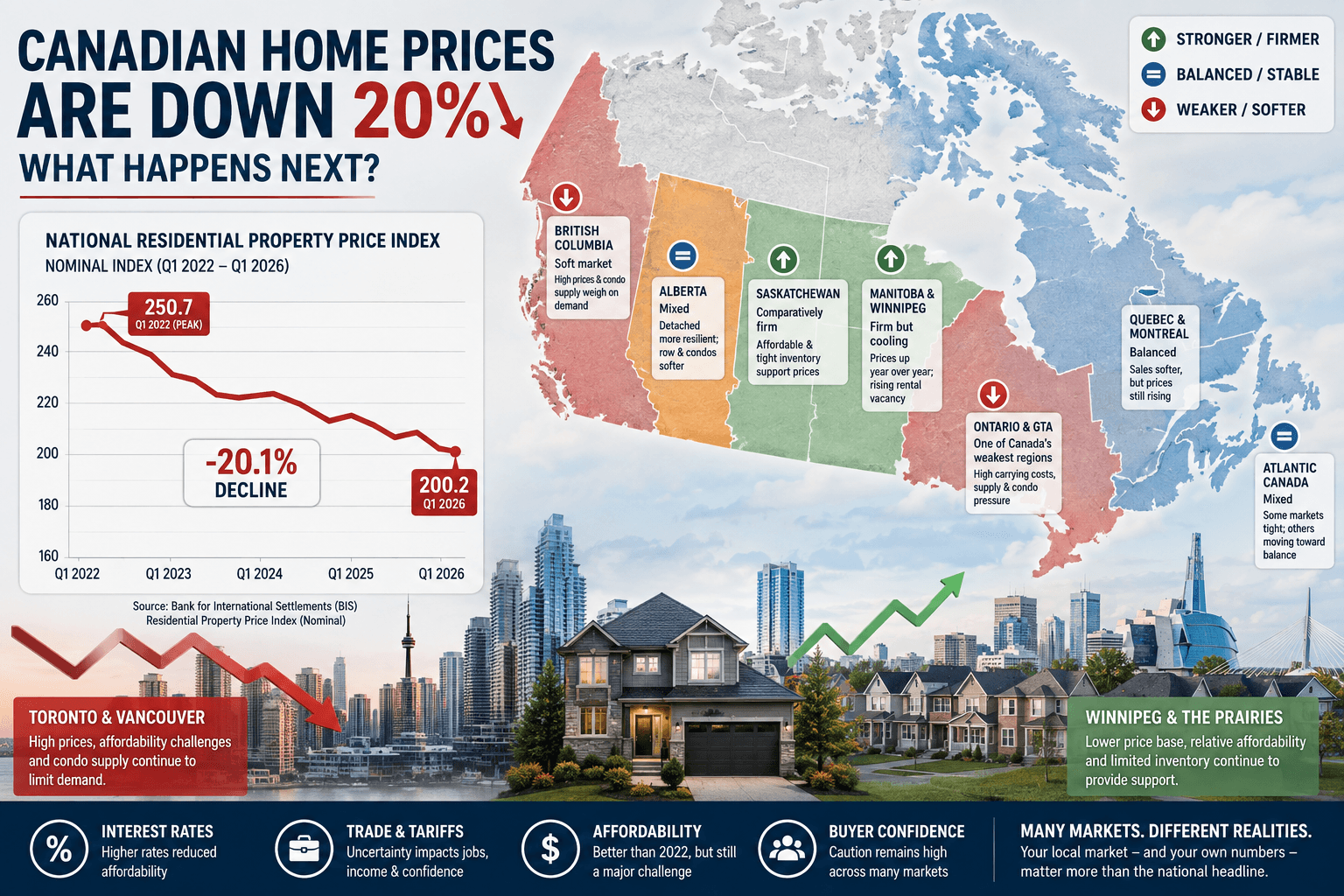
In other words, Canada’s market is not moving in one simple direction. Some regions are cooling. Some are stabilizing.
Some remain under pressure. Some rental markets are seeing more supply, while others continue to experience
affordability-driven demand.
American interest may affect the market in several ways:
First, it can add demand to rental markets. If Americans are interested in Canada but cannot or do not immediately
buy, many will rent before making long-term decisions. That can support demand for well-managed rental homes,
especially in cities with relative affordability.
Second, it can increase attention on mid-priced Canadian markets. Toronto and Vancouver may dominate international
headlines, but many Americans comparing prices may quickly realize that smaller and mid-sized Canadian cities offer
more accessible entry points.
Third, it can influence investor sentiment. Even if U.S. buyers are not purchasing in large numbers today, increased
cross-border attention can make Canadian property owners more aware of the global appeal of their local market.
Fourth, it can intensify the affordability debate. Canada already faces concerns about housing access, investor
activity, and the role of outside capital. Any increase in foreign interest, even if restricted by law, can affect
public perception and policy conversations.
Why Winnipeg Could Stand Out
A Canada-wide article about Americans moving to Canada should not ignore Winnipeg.
Winnipeg does not usually receive the same international attention as Toronto, Vancouver, Montreal, or Calgary. But
that can be part of its appeal. For people comparing Canadian cities, Winnipeg offers a combination of relative
affordability, established neighbourhoods, rental demand, and a stable long-term housing market.
Canopy Mgmt has previously noted that Winnipeg’s real estate market often tells its own story compared with larger
Canadian markets. In a recent market article, Canopy described Winnipeg as a traditionally more affordable market
where rental property investment is often less about rapid appreciation and more about building steady value over
time.
Read Canopy’s Winnipeg real estate market 2026 outlook
.
That matters for American interest because affordability is relative. A Winnipeg home may feel expensive to local
first-time buyers, but compared with many large U.S. metros and Canada’s most expensive cities, Manitoba can look more
approachable.
For Canadian landlords, that does not mean every American searcher is a future tenant or buyer. But it does suggest
that Winnipeg could benefit from broader awareness as people look beyond Canada’s headline markets.
A person considering Canada may begin by searching Toronto or Vancouver, then quickly discover that prices, taxes,
competition, or lifestyle preferences make other regions more attractive. Winnipeg may become more relevant for those
looking for a practical, livable, lower-cost Canadian city with rental options and long-term investment potential.
What This Means for Manitoba Landlords and Property Owners
For Manitoba landlords and Winnipeg property owners, the biggest near-term opportunity may be rental demand.
If Americans are exploring a move to Canada, many will need rental housing before they buy. Some may arrive for work,
family, education, or lifestyle reasons. Others may test the waters before committing. Some may already be connected
to Canada through citizenship, permanent residency, marriage, or employment.
This creates an opportunity for landlords who provide clean, well-maintained, professionally managed rental homes.
However, landlords should not assume that cross-border tenants are automatically simple to place. International or
out-of-country applicants may have different documentation, employment structures, credit history, references, or
timing needs. Screening remains essential. So does compliance with Manitoba tenancy law.
Canopy Mgmt’s landlord resources emphasize that successful property ownership involves more than collecting rent.
Landlords need strong communication, prompt maintenance, rent collection systems, financial tracking, inspections,
lease renewals, and compliance with Manitoba’s Residential Tenancies Branch.
Read Canopy’s guide to landlord rights and responsibilities
.
For out-of-province or international owners, the operational side becomes even more important. A rental property is
only a good investment if it is managed properly.
Why Property Management Matters for U.S.-Based or Out-of-Province Owners
Some Americans may already own property in Canada from before the federal restrictions took effect. Others may be
eligible under an exemption. Some may become permanent residents in the future. Others may purchase property outside
the restricted categories or pursue development-related opportunities with professional guidance.
In any of these cases, local property management becomes critical.
A U.S.-based owner cannot easily inspect a property, meet contractors, respond to emergency maintenance, attend
move-out inspections, show a vacant unit, or navigate local tenancy requirements from another country. Even owners
living in another Canadian province face similar challenges.
That is where a full-service Winnipeg property manager can make the difference between a stressful long-distance
rental and a stable, income-producing asset.
Canopy Mgmt’s property management services include residential rental management for single-family homes, duplexes,
triplexes, fourplexes, and condo units in Winnipeg.
Learn more about Canopy’s property management services
.
For landlords who want a clearer look at service options, Canopy’s pricing page lists services such as income and
expense tracking, maintenance coordination, rent collection, bi-annual inspections, tenant water account monitoring,
lease renewals, tenant placement, professional listing photos, and support related to Manitoba’s Residential Tenancies
Branch.
View Canopy Mgmt property management pricing
.
These services are especially relevant for owners who are not physically present in Winnipeg. They help protect the
property, support tenant satisfaction, reduce vacancy risk, and create a professional buffer between the owner and
day-to-day problems.
The Rental Market Connection
The Americans Moving to Canada interest story is not only about home purchases. It is also about rentals.
If someone is searching “Americans moving to Canada,” they may also be searching for apartments, homes for rent,
neighbourhood information, schools, employment, health care, and cost of living. Rental housing is often the first
real estate step in a relocation journey.
Canopy Mgmt has previously written about Canada rent prices falling nationally while some Prairie markets remain more
resilient. The article noted that average rents across Canada had declined year over year, but Prairie markets,
including Manitoba, may behave differently because of affordability and demand dynamics.
Read Canopy’s article on Canada rent prices in 2026
.
For landlords, this means pricing strategy matters. If national rents are softening but Winnipeg demand remains
steady, landlords still need to avoid overpricing. A well-priced, well-maintained rental can outperform a poorly
presented property, especially when tenants have more choice.
American renters relocating to Canada may also be comparing cities carefully. They may not know Winnipeg
neighbourhoods, commute patterns, school divisions, winter realities, or rental norms. Strong listings, professional
photos, clear communication, and reliable maintenance can help a property stand out.
Canopy’s available rental listings page is a natural resource for tenants searching for homes in Winnipeg.
Browse available properties for rent in Winnipeg
.
The Affordability Debate: Opportunity and Concern
Any article about Americans buying Canadian real estate or Americans Moving to Canada must address affordability
honestly.
Canada has a serious housing affordability challenge. Many Canadians already feel priced out of homeownership, and
renters in many cities have faced years of rising costs. When outside demand enters the conversation, it can create
concern that local buyers and renters will face even more competition.
The federal government’s extension of the foreign-buyer ban was explicitly framed as part of a broader effort to make
housing more affordable. The Department of Finance stated that foreign ownership had contributed to worries about
Canadians being priced out of housing markets in cities and towns across the country.
That concern is valid.
At the same time, not all American interest is speculative. Some Americans are looking at Canada because they want to
live here, work here, join family, rent before buying, or become long-term residents. Others may be Canadian citizens
returning from the United States. Some may be dual citizens or permanent residents. Others may be investors in
categories not captured by the typical “foreign buyer” narrative.
For landlords and investors, the balanced view is this: outside interest can support demand and market confidence, but
housing policy must still prioritize livability, affordability, and supply.
A healthy market is not one where prices rise endlessly. A healthy market is one where owners can earn fair returns,
tenants can access quality housing, and communities can grow without pushing residents out.
What Canadian Investors Should Watch
Canadian landlords and investors should watch several indicators over the next year.
The first is rental demand from newcomers. Even if permanent resident targets, work permits, and immigration rules
shift, people moving to Canada still need housing. American interest may be one small part of a larger rental demand
picture.
The second is regional affordability. If Toronto and Vancouver remain out of reach for many buyers, cities such as
Winnipeg may continue attracting attention from people seeking better value.
The third is foreign-buyer policy. The current federal prohibition is extended to January 1, 2027. Any changes before
or after that date could affect demand, especially in residential investment categories.
The fourth is interest rates and financing. Both Canadian and U.S. buyers are sensitive to borrowing costs. If rates
stabilize or decline, sidelined demand could return.
The fifth is rental competition. More supply can help tenants, but it requires landlords to be sharper with pricing,
marketing, maintenance, and tenant experience.
For Winnipeg property owners, the practical lesson is to operate professionally. Whether demand comes from local
renters, Canadians relocating from another province, international tenants, or Americans exploring Canada, the
fundamentals are the same: good housing, fair pricing, responsive service, and legal compliance.
Related Reading from Canopy Mgmt
For landlords and investors who want to better understand the Winnipeg rental market, these Canopy Mgmt resources are
worth reading:
Winnipeg Real Estate Market 2026: Should Investors Buy or Rent?
Winnipeg Real Estate Market 2025 Review & 2026 Outlook
Canada Rent Prices Continue to Fall — What It Means
Landlord Rights, Duties and Responsibilities in Manitoba
What Does a Property Management Company Do?
- Property Management Services in Winnipeg
- Property Management in Winnipeg
External Sources and Further Reading
For readers who want to explore the topic further, these external resources provide useful context:
Statistics Canada: Recent trends in U.S.-to-Canada migration
CMHC: Prohibition on the Purchase of Residential Property by Non-Canadians Act
CMHC: Foreign-buyer ban FAQ
Government of Canada: Extension of the foreign-buyer ban
CMHC: Housing Market Outlook
CREA: Canadian housing market quarterly forecasts
Global News: U.S. searches about moving to Canada
Royal LePage: U.S. traffic spike after 2024 election
Final Thoughts: A Trend Worth Watching, Not Overhyping
The rise in Americans moving to Canada searches is real. U.S. traffic to Canadian real estate websites has spiked
during major political moments. News coverage continues to show that Canada remains a popular relocation idea for
Americans during periods of uncertainty. Statistics Canada also confirms that U.S.-to-Canada migration has
historically been influenced by social, political, and economic conditions.
But Canadian landlords and investors should avoid exaggerated conclusions.
American interest does not automatically mean an unrestricted wave of U.S. buyers entering the Canadian real estate
market. Canada’s foreign-buyer rules remain a major factor. Many interested Americans may rent first, delay a
purchase, pursue immigration pathways, or never move beyond online research.
For Winnipeg and Manitoba property owners, the more realistic takeaway is that Canada’s relative stability and
Manitoba’s relative affordability could continue to attract attention. That attention may support rental demand,
especially for well-managed homes in practical, livable neighbourhoods.
For investors, this is not a reason to speculate blindly. It is a reason to stay informed, manage properties
professionally, price rentals strategically, and understand how broader migration and affordability trends can affect
local demand.
If you own a rental property in Winnipeg, or you are considering turning a home into a rental, Canopy Mgmt can help
you manage the details. From tenant placement and rent collection to maintenance coordination, inspections, lease
renewals, and owner reporting, professional property management can help protect your investment while providing a
better experience for tenants.
The Canadian real estate market is changing. Americans Moving to Canada interest is one piece of that story. For
Winnipeg landlords, the opportunity is not just in watching the trend — it is in preparing your property to perform
well no matter where future demand comes from.
Disclaimer:
This article is for general informational purposes only and should not be taken as legal, immigration, tax,
accounting, mortgage, or financial advice. Rules for non-Canadian property purchases, taxation, financing, and
residency can change. Buyers, sellers, landlords, and investors should speak with qualified professionals before
making real estate decisions.