last updated: March 10th 2026
According to local reports and project materials, Jet.AI and Consensus Core have formed a joint venture. They are promoting a 350-acre AI data center campus. They plan it north of Île-des-Chênes in the RM of Ritchot.
People now discuss Île-des-Chênes, a small community just southeast of Winnipeg, alongside artificial intelligence. It also connects to hyperscale computing and Canada’s digital infrastructure. That alone tells you how unusual this proposal is.
The developers said the site is uniquely attractive. Close to major electrical infrastructure, fibre routes, and natural gas assets. It also has potential for multi-hundred-megawatt development. Local reports also say the plan could include six working turbines.
They also say the land is near the Riel Converter Station and a Manitoba Hydro substation.
Major Proposal for AI Data Center in Île-des-Chênes
That combination of scale and infrastructure is exactly why supporters see opportunity and why residents see risk. A project like this would not be a small industrial building tucked out of sight.
It would significantly change how the community uses nearby land. People mostly associate this community with homes, farms, open space, and a quiet rural life.
Residents have already started organizing against the idea. They have also launched an online petition.
Mayor Chris Ewen said the proposal has not yet gone before council. He said any future review would look closely at land use.
It would also consider nearby residents. It would assess job potential and economic benefits. It would also review environmental impacts.
That is why the idea of a data center in Île-des-Chênes has become such a flashpoint. It sits where two powerful stories meet. Manitoba wants to join the AI economy. A local community wants to protect its character, resources, and property values.
The real question is not whether AI data centers matter to the modern economy. They clearly do. The real question is whether this is the right project.
Is it in the right location? Does it have the right safeguards? Would the benefits truly outweigh the long-term trade-offs for Southeast Manitoba?
What are you proposing, and where exactly will it go?
The proposal discussed publicly is a large AI data center campus on the north side of Île-des-Chênes. About 10 miles south of Winnipeg. Reporting places the site in a block framed by Arnould Road and Highway 59 east-west.
Mondor Road and Provincial Road 405 frame it north-south. Project materials highlight quick access to electrical infrastructure, east-west fibre routes, and natural gas. This is why people pitch the land as a “Goldilocks” site for high-density compute.
In practical terms, this is not a generic office-data facility. They’re marketing it as a campus-scale development for AI and other high-density computing uses.
Earlier reports linked the project to a first 100-megawatt phase. The project could later reach 500 megawatts.
However, public reports so far do not fully present the final build-out. They also do not fully cover phasing, water strategy, or the full technical design.
That uncertainty matters. With a project of this size, the unanswered questions are just as important as the promotional materials.
Separating a proposal from an approval is also important. At this stage, the public story is still early.
Mayor Ewen said someone approached the municipality about the land in late 2025.
He said the concept has not yet come before council in a formal way. He also said that authorities rezoned part of the wider area years ago.
A crypto-mining plan that never went ahead was the reason. In other words, the public is paying attention, and there is organized opposition.
But there is still no final city yes-or-no decision on a formal application.
Why Manitoba wants more AI data centers
The bigger policy context matters here. Manitoba is not looking at AI infrastructure in a vacuum. Manitoba’s innovation and productivity report clearly said that the province should take more control of its data. It should also take more control of its AI and computing systems.
It also urged Manitoba to build more “sovereign compute” with provincial and federal funding. The logic is simple. If AI boosts productivity, research, government services, and private-sector growth, provinces that host the infrastructure may benefit more. They may capture more talent, tax revenue, investment, and strategic value.
Premier Wab Kinew’s government has used similar language in public. They say Manitoba is ready to “punch above its weight” in the AI economy. They also say the province should use AI to create good jobs. They want AI to build prosperity at home.
At the federal level, Ottawa’s Sovereign AI Compute Strategy has committed up to $2 billion. This includes up to $700 million for new or expanded AI data center projects. It also includes up to $1 billion for public computing infrastructure.
Ottawa’s 2026 call for large-scale sovereign AI data center proposals targeted projects above 100 megawatts. It also showed a preference for projects with a credible path to completion. It favoured strong environmental safeguards and Canadian partnerships.
That helps explain why data center in Manitoba is no longer a niche phrase. Manitoba offers real strategic advantages on paper: strong hydro-electric power, abundant freshwater, and available land near Winnipeg.
The policy environment also increasingly views digital infrastructure as economic infrastructure. For governments, the pitch is not just more servers. The focus is on an economic revamp, building AI capacity at home, and improving resilience. It also aims to keep more value-added work in Canada.
Future of housing in the Winnipeg Metropolitan Region
Still, governments and developers do not get the final word on whether a site is appropriate. Local communities do not live inside strategy documents. They live beside roads, substations, farmland, wildlife areas and family homes. That is where the community reaction in Île-des-Chênes becomes central.
How the community has reacted so far
The local reaction has been cautious at best and openly resistant at worst. Reporting from the area shows residents raising concerns about the project’s size. They worry about a constant industrial hum.
They also fear strain on natural resources. They cite possible effects on wildlife. They question adding another major utility-heavy operation nearby.
This is near an area that already has infrastructure noise. Some residents link their anxiety to past disputes about nearby energy infrastructure. They say earlier noise was severe and led to legal action and mitigation.
Many rural infrastructure debates also involve a credibility issue. When technical details are limited, residents often imagine worst-case scenarios. That does not mean those worries are irrational.
It means uncertainty itself becomes part of the problem. If people do not know how much water the site will use, they may oppose it early.
If they do not know how traffic will work, they may oppose it early.
If they do not know what buffer zones will be in place, they may oppose it early.
If they do not know how loud it could be, they may oppose it early.
If they do not know what emergency and environmental controls will apply, they may oppose it early. Brookings noted that rural communities now weigh tax revenue and infrastructure promises against land-use change and grid strain. They also weigh water demand and who bears the risks versus who gains the benefits.
That is one reason the petition matters, even before someone files a formal application. Whether an online petition can decide planning policy on its own matters less. What it signals matters more. Community concern is already organized, visible, and politically relevant.
Once that happens, a project stops being purely technical. It becomes social, cultural and electoral.
What could the impacts be on the town and surrounding area?
Electricity
AI Data centers are power-hungry by design, and AI data centers are even more so. The World Resources Institute notes that one modern AI data center can use as much electricity as 100,000 homes. The largest facilities can use many times more.
That does not automatically mean a proposed campus near Île-des-Chênes would create residential blackouts. But it does mean electricity should be one of the first questions asked, not the last:
How much power would the project need? What upgrades would we need?
Who would pay for them? Would we need special rate structures to keep costs from shifting onto households or smaller businesses? WRI notes that some jurisdictions have already created special billing classes for immensely large energy users. I did this for that reason.
The site draws developers for the same reason it concerns residents. It appears to be close to curiously strong infrastructure.
Nearby access to the Riel Converter, transmission assets, and substation capacity may make this project more feasible. This may be true almost anywhere else in Manitoba. But odds for a developer is not the same thing as adequacy for a host community.
Natural gas and air quality
One of the more controversial aspects of the reported concept is the natural-gas angle. Public reports and project descriptions show the site is close to gas infrastructure. Local reports say the plan could include six operating turbines.
WRI warns that some AI data centers use gas-fired power not only for backup. In some cases, they use it for routine operations. This can cause ongoing greenhouse gas emissions.
It can also raise local air quality concerns. In this province, electricity depends heavily on hydropower. A gas-supported AI campus will likely face more scrutiny.
That does not mean the project is automatically environmentally inferior. It means the developer should expect direct public questions about emissions and operating patterns.
People may also ask about backup systems and flare or turbine noise. They may ask whether you fully evaluated lower-impact energy or storage options. Where gas is part of the equation, transparency becomes essential.
Water
Water may be the most emotionally charged issue because it is both technical and deeply local. WRI says mid-sized AI data centers can use up to 300,000 gallons of water a day.
Large facilities can use up to 5 million gallons a day.
That equals about 1.1 million to 18.9 million litres each day. Exact water demand depends on the cooling design and local climate. It also depends on air cooling, liquid cooling, or reclaimed wastewater use.
That is why people cannot discuss water in slogans. We have to discuss it in engineering terms.
For a data center in Île-des-Chênes, the key point is simple. Even if the final design uses less water than residents fear, water sourcing needs clear public explanation. Peak demand also needs clear public explanation.
Elsewhere, governments have responded to AI data center growth with water-use monitoring, site-specific risk assessments and contingency planning. Those are the kinds of safeguards that should be on the table here if the project advances.
Farmland, land use and environmental change
A 350-acre campus is a major land-use decision in a rural municipality. Even if the site is technically well-placed, building a large AI campus on farm land changes the landscape.
It can also change it for good.
Brookings notes that AI data centers need more land and strong utility access. They often provide fewer long-term on-site jobs than people expect. WRI also points to tensions around land conversion, setbacks, traffic, stormwater management and habitat impacts.
This matters in Southeast Manitoba because farmland is not just open space. Economic land, visual identity, and community identity.
Once a rural area starts developing, the change can spread beyond the project site. It can shape how marketers promote the area, how people see future land, and how residents view long-term growth.
That was a key issue in Rocky View County, Alberta. Officials rejected a large AI data center campus proposal. They cited concerns about the site and impacts on local agricultural producers.
Noise and quality of life
Noise sounds like a secondary issue until you talk to people who live near large infrastructure. WRI says the most common sources are construction, cooling equipment, and generators.
It notes that mitigation can include setbacks, acoustic barriers, decibel limits, and ongoing monitoring. In the Île-des-Chênes debate, noise is not theoretical; it is one of the first concerns residents have raised. That alone makes it a front-end planning issue, not something we can brush aside until later.
A quiet rural setting is part of the product people believe they are buying when they move to communities like Île-des-Chênes. That does not mean no development should ever happen. It means noise, lighting, buffering, and operating hours must be core approval conditions, not optional extras.
The case for the project: what are the real positives?
A balanced view has to acknowledge that there are real potential upsides.
First, there is the economic-development argument. Constructing a large campus can create hundreds of temporary jobs.
Long-term staffing is often smaller than headlines suggest.
Still, it brings ongoing skilled roles, security jobs, and maintenance trades.
It can also add service contracts and affect the local tax base. Brookings and WRI note that local governments often want AI data centers for revenue and infrastructure investment.
Second, there is the strategic argument. Manitoba does have a plausible case for wanting more digital infrastructure.
If AI is becoming important to the economy, hosting computing capacity can help. It may attract nearby businesses, researchers, and technical talent. That is the reason behind Manitoba’s sovereign-compute push and Ottawa’s large AI data center funding plan.
Third, there is the municipal bargaining argument. In stronger jurisdictions, communities do not simply say yes or no. They negotiate. WRI highlights tools such as water monitoring, noise controls and community-benefit agreements.
If a project like this were ever to move forward, the best version of it would not be a blank cheque. A tightly conditioned approval with enforceable limits and measurable benefits.
What could a data center in Île-des-Chênes mean for real estate?
From a real-estate standpoint, this is where the discussion becomes especially important for Canopy’s audience.
The first thing to say is that there is no proven local sales pattern yet.
It does not show what this proposal has done to home values in Île-des-Chênes.
No one has approved or built a formal project yet. Any honest real estate assessment must focus on likely market behaviour.
It should not pretend there is already a clean local data set.
The likely short-term effect is not a dramatic overnight collapse in values across Southeast Manitoba. The likelier effect is uncertainty, and uncertainty changes buyer behaviour. Homes closest to the proposed site, along likely traffic routes, or near areas linked to noise may face more questions. They may also see fewer buyers and tougher negotiations at first.
In a rural market, perception matters. Buyers are often paying for quiet, views, open land and a certain lifestyle story. When the story is unclear, the resale value often faces pressure.
This pressure usually appears first in how easy it is to sell.
It does not **appear** as one large percentage drop right away. That is an inference supported by Brookings’ broader pattern.
Rural communities weigh land-use change, utility strain, and quality-of-life impacts. They weigh these impacts against benefits that can be meaningful. Yet those benefits are often unevenly shared.
That said, the long-term picture is not automatically negative in every location. A recent George Mason University study of Northern Virginia home sales found a clear pattern.
Homes closer to AI data centers sold for more. The authors said this likely reflects where those facilities cluster. They tend to be in infrastructure-rich, amenity-rich areas. These areas often have strong roads, utilities, and easy access to jobs.
In other words, being nearby did not lower values in that market. However, the study does not prove that every rural community near a proposed AI data center will benefit. It does, however, remind us that real estate outcomes depend on context, planning quality, and the place around it.
For rural manitoba real estate specifically, the most likely real-estate split would look something like this:
Properties closest to the proposal could face buyer hesitation, especially from households specifically seeking rural quiet or farmland adjacency. Properties farther away may experience much less impact. Good commuting access may also affect some properties less. This is especially true if they have no direct exposure to the site.
At the same time, the project may bring real infrastructure upgrades. It may also strengthen the tax base. It could create spillover business activity.
If that happens, early market fear may fade over time. That is why resale value is the right lens here. Real estate responds to more than what builders construct. It reacts to what buyers believe is likely to happen next.
A land-market angle also exists. In some U.S. regions, AI data center development now competes with housing for land. This raises site prices and complicates new home supply.
That dynamic is strongest in major growth corridors. Rural Ritchot is not as intense today. Still, it matters as a warning. Once high-power industrial users target a region, the land conversation changes.
On seller disclosure, the practical takeaway is cautious but simple. Manitoba’s standard property disclosure framework relies on what the seller actually knows.
If the seller provides a disclosure statement, the seller must answer accurately. That does not mean every nearby proposal automatically becomes a formal defect disclosure issue.
It means sellers should expect buyers to ask more questions. Buyers will review more details. They will also do more due diligence in areas connected to a high-profile project debate.
For homeowners near the proposed site, the smart move is not to guess. It helps you have clear, informed discuss about location and future land use. It also shows what experts confirm and what they guess about.
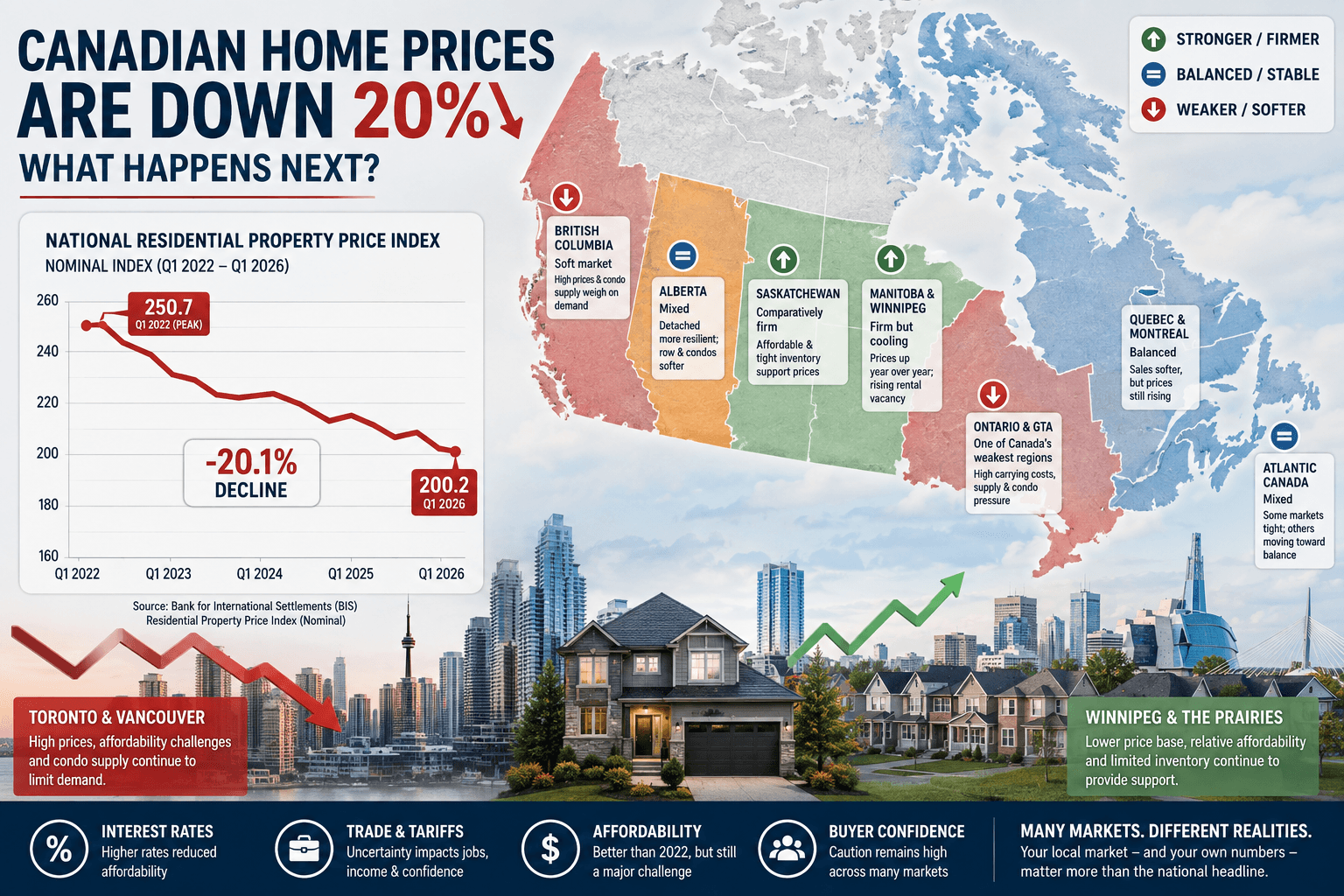
Exciting Trends in the Winnipeg Real Estate Market 2025-26
The upside for real estate, if there is one, may be indirect. It could mean a stronger economic story, better infrastructure, and more investor interest in Southeast Manitoba. The downside is more immediate and easier to understand: stigma, uncertainty, and a possible mismatch.
It may not match what local buyers want from Île-des-Chênes. It may not match what a large industrial-tech campus represents.
Neutral but cautious is the right stance. The local housing market has more to lose from unmanaged impacts. It has less to gain from vague promises alone.
Unlocking a Bright Future: Real Estate Investing for Retirement in 2026
A similar Canadian case where residents pushed back and the project was stopped
The clearest recent Canadian comparison is Rocky View County, Alberta. In September 2025, council rejected Kineticor’s proposed Area Structure Plan.
An AI data center campus covered about 448 hectares.
That is about 1,107 acres. Rocky View said concerns about the location and its impact on agricultural producers primarily drove the decision. The county also explicitly said that without approval of the plan, the development could not proceed.
Just as important, Rocky View’s official summary said the community was “well represented” at the public hearing. Residents spoke with passion about their lifestyle and their commitment to agriculture.
The proposal included technical studies and power for a first phase. Still, it did not ease concerns. People worried about farmland, project fit, and the local vision.
That is a useful lesson for Manitoba. Even in a province or region that wants AI investment, decision-makers may reject a rural site. This can happen if residents and council decide the location is wrong.
A similar rural case where AI data centers were built, and what happened after
Few long-running, AI-specific rural campuses still offer years of public evidence since builders completed them. This is because the current AI boom is so new.
The best long-term rural example is Quincy, Washington. A farming community exists. It has hosted major AI data center growth for years.
Washington’s hydropower has created a data center boom. Some are concerned about its future.
The positive side is real. Oregon Public Broadcasting reported that AI data centers make up about 75% of Quincy’s property-tax revenue. This helps fund local amenities, including a medical centre. KUOW also reported that one facility may employ 50 workers or fewer.
Still, the cluster as a whole has become a meaningful job creator.
Residents can point to a high school, a hospital, and other infrastructure.
Tax revenue helped support them.
But the negatives did not disappear. Even in Quincy, critics continued to raise concerns about long-term electricity and water impacts.
That is the more realistic lesson for AI data center in Manitoba. A rural community can gain real fiscal and infrastructure benefits from AI data centers. But those benefits do not remove utility strain or land-use conflict. They simply mean the trade-off is real on both sides.
For a clear AI-era example, Abilene, Texas shows how fast large AI campus projects can strain a small market. Early reports on the Stargate project described a rush of outside workers. Rents rose fast.
Motels and RV parks filled up. A housing shortage that already existed got worse. That is not a direct one-to-one comparison with Île-des-Chênes.
But it does show how fast a rural or small-city market can feel housing ripple effects.
This can happen when a huge AI project ramps up.
How the AI Boom Sparked a Housing Crisis in One Texas City
From Energy Use to Air Quality, the Many Ways AI Data Centers Affect US Communities
What are the next steps in Île-des-Chênes?
Right now, the next steps are more about process than bulldozers.
The first near-term step is continued public organizing. Residents already have a petition. They have started building a public story about farmland, water, noise, and community fit. That matters, because early organization often shapes how council approaches any later application.
Stop the AI data campus near Ile Des Chênes
The second step, if the developer formally advances the project, would be municipal planning review. Manitoba’s planning rules require public hearings for zoning by-laws and amendments.
Conditional-use processes include public notice before a hearing.
They also give residents a chance to make representations.
Council or the local board then makes a decision.
It can approve, reject, or impose conditions. Since Mayor Ewen says the proposal has not yet come before council, that public-hearing stage is still ahead rather than behind.
The Manitoba Planning Act Handbook
The third step should be substance, not slogans. If this project becomes a real application, the public deserves clear details on these points.
These include total power demand and gas generation details.
They also include water sourcing and daily water demand.
They should cover the cooling method and traffic and road impacts.
They should address drainage and stormwater issues.
They should include noise modeling and lighting plans.
They should explain setbacks and buffering.
They should describe emergency response plans.
They should cover wildlife and habitat impacts.
They should state what guaranteed measurable local benefits they would provide.
Other jurisdictions have already shown that these are standard questions, not anti-development questions. They are the minimum questions that a project of this scale should answer.
For local homeowners, buyers and sellers, the next step is to pay attention early. Real-estate markets do not wait for ribbon-cuttings to form opinions. They react during the uncertainty stage.
Anyone who owns, buys, or lists near the proposed area should watch municipal agendas and public notices. They should also check confirmed site plans and the tone of the debate. Don’t rely only on social-media chatter.
Final thoughts
This is also not automatically an economic miracle.
The optimistic case is clear. Manitoba wants to be part of the AI economy. Digital infrastructure can bring construction jobs and tax revenue. A well-planned project could strengthen the province’s long-term tech position.
The cautious case is clear too. This is a large industrial use beside a rural community. People have valid questions about electricity, gas, and water. They also worry about farmland, environmental impacts, noise, and resale value.
The most responsible position is neither reflexive boosterism nor reflexive fear. Disciplined scrutiny.
For Canopy Management’s audience, the real-estate takeaway is straightforward. The biggest near-term risk is uncertainty and perception, especially for properties closest to the proposed site. The project would create the biggest long-term opportunity only if the team planned it in a clear way.
It must have strict conditions.
It must also show benefits without harming the qualities that make Southeast Manitoba desirable.
Concerned about how a major infrastructure proposal could affect resale value, buyer demand or investment strategy in Southeast Manitoba?
Canopy Mgmt helps Manitoba property owners and investors plan for changing markets.
We help you assess and make long-term property decisions. Contact our team to talk through your next move.
Frequently Asked Questions
What is being proposed near Île-des-Chênes?
Public reports describe a proposed 350-acre AI data-centre campus north of Île-des-Chênes.
Jet.AI and Consensus Core are tied to it.
The initial development target is reportedly about 100 megawatts.
Long-term expansion could reach up to 500 megawatts.
Where would we locate the proposed site?
Local and industry reports place the site on the north side of Île-des-Chênes. About 10 miles south of Winnipeg. Near Highway 59, Provincial Road 405, Arnould Road, and Mondor Road.
Has the RM of Ritchot approved the project?
No one has reported formal approval. Local coverage says someone contacted the municipality, but the proposer has not formally presented it to council yet.
Why does Manitoba want more data centres?
Manitoba’s Innovation and Prosperity Report recommends building more local data and AI infrastructure. This will help the province gain more economic value, attract talent, and boost resilience in the AI economy. Canada’s Sovereign AI Compute Strategy aims to increase Canada’s computing capacity.
Its large-scale data-centre program also aims to expand computing capacity in Canada.
They support researchers and businesses.
What are residents most concerned about?
The main public concerns include loss of farmland. They also include water use. People are worried about electricity demand and natural gas use. They also mention noise.
Other concerns include impacts on wildlife.
Many are also concerned about long-term changes to rural character. Those concerns match wider research.
It shows large data-centre projects can affect local power systems. They can also impact water supplies, land use, and quality of life. This can happen if they do not govern it carefully
Could the proposed project affect local home values?
We cannot analyze any post-construction local sales pattern yet because the project lacks approval and construction.
The most likely near-term effect is uncertainty. Homes closest to the proposed site may face more buyer hesitation.
Longer-term value impacts would depend on the final site. They would also depend on noise, buffering, and infrastructure changes. They would depend on how the market views the trade-off.
That trade-off is between economic upside and loss of rural lifestyle. Research in Northern Virginia found higher home prices near data centres in that market.
But that result comes from an infrastructure-rich area.
You should not assume it applies directly to rural Manitoba.
Would sellers need to mention the proposal when listing a home?
In Manitoba, sellers complete the property disclosure statement to the best of their knowledge. Consumer guidance encourages buyers to request one. Whether a nearby proposal becomes a disclosure issue depends on the listing facts. Sellers should answer truthfully and clearly state what they know versus what they speculate about.
Is there a Canadian example where residents stopped a similar project?
Yes. In Rocky View County, Alberta, council rejected Kineticor’s proposed AI data-centre campus plan. They cited concerns about the site and impacts on local agricultural producers.
What happens next in Île-des-Chênes?
If the project advances, the next major step will likely be Manitoba planning and municipal review. This can include public notice, hearings, zoning or conditional-use decisions, and possible development agreements. That is the stage where petitions, public submissions and council attendance matter most.