National data shows that a large share of household wealth in Canada is tied up in real estate, with residential property making up a significant portion of net worth for most families.In this context, real estate investing has effectively become a retirement plan. And increasingly, investors are looking to Manitoba for a balance of affordability, stability, and long-term income potential.In this article, we’ll explore why real estate plays such a central role in Canadian retirement planning, how Manitoba compares to the rest of the country, what risks investors should be aware of, and how working with
a property management company in Winnipeg can make it easier to get started with rental property investing.
Real Estate as a Retirement Plan in Canada
Compared to many other countries, Canadian households hold an unusually large share of their wealth in property.
Homes, condos, duplexes, and small multifamily buildings are not just places to live—they are long-term financial tools.
Real estate supports retirement in several ways:
- Forced savings: Paying down a mortgage over 20–25 years steadily builds equity.
- Long-term appreciation: Despite cycles and corrections, Canadian home values have trended upward over the past few decades.
- Rental income: Investment properties can generate monthly cash flow that supplements other retirement income.
- Downsizing or selling: Many Canadians eventually sell their primary home or a rental property to unlock equity during retirement.
When you combine equity growth with the potential for rental income, it’s easy to see why using real estate for retirement has become so common in Canada.
Why Manitoba Is an Attractive Real Estate Retirement Market
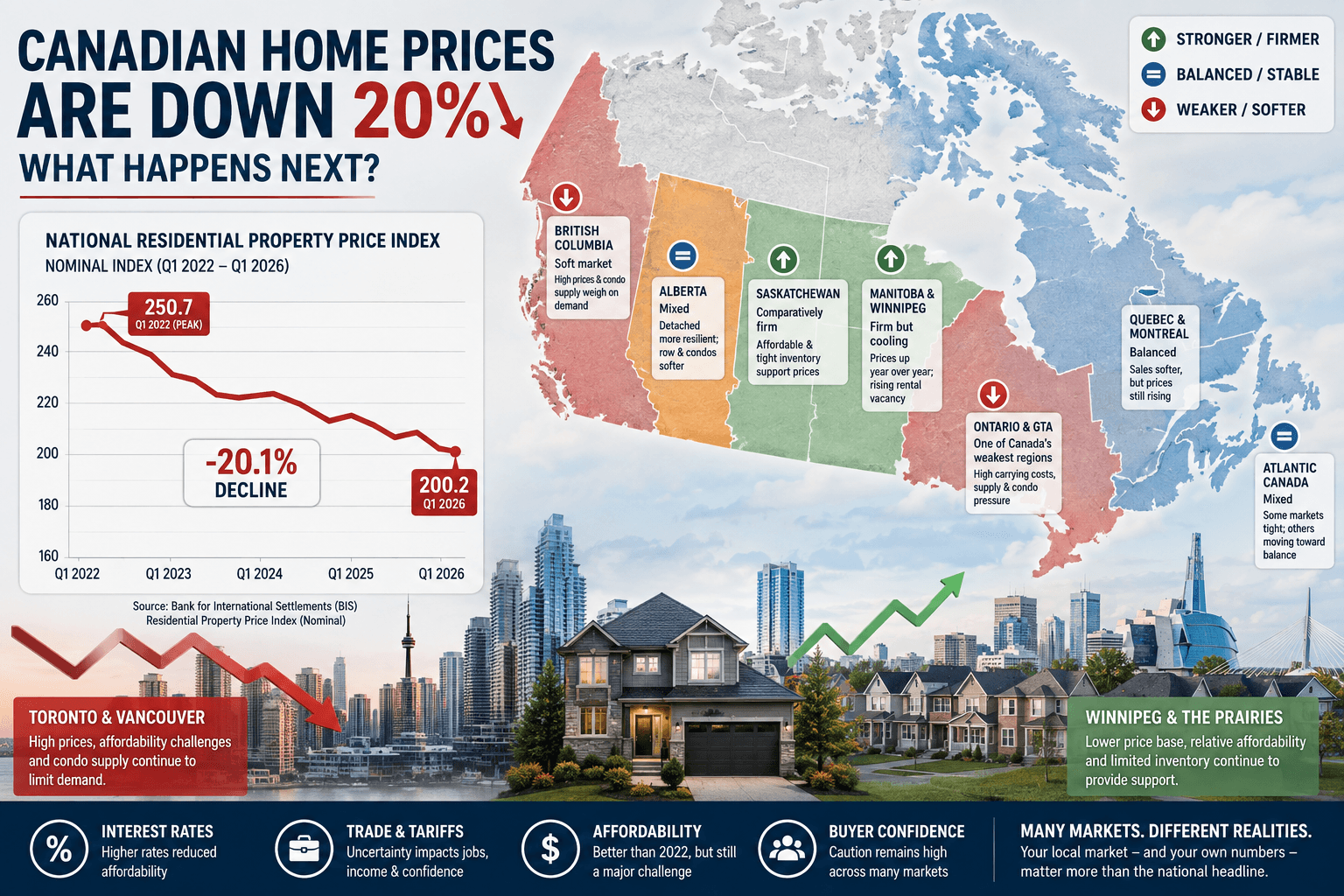
While provinces like Ontario and British Columbia tend to dominate the national conversation, Manitoba offers something that’s increasingly rare:
a mix of relative affordability, stable demand, and solid rent-to-price ratios.
In markets where home prices are lower relative to incomes, investors can often:
- Enter the market with a smaller down payment.
- Achieve healthier cash flow from rental properties.
- Reduce the risk of being over-leveraged at retirement.
CMHC rental market data for Manitoba shows a long-term pattern of steady rental demand and gradually rising average rents, alongside relatively moderate vacancy rates over time.
That combination supports a more predictable long-term investment profile for landlords and retirement-focused investors.
For people planning to use Manitoba real estate investing as part of their retirement strategy, the province offers a compelling balance between risk and reward.
How Much of Canada’s Wealth Is in Real Estate?
Statistics Canada’s balance sheet and wealth distribution reports show that Canadian households hold a large portion of their net worth in non-financial assets, especially residential real estate investing.
When you compare this to financial assets like stocks, mutual funds, and pensions, property consistently makes up a large share of the total.
This has big implications:
- Many Canadians are overweight real estate in their personal balance sheet.
- Household wealth is tightly linked to housing market performance and interest rates.
- Retirement timelines and lifestyle expectations often depend on the value of a primary home or rental portfolio.
In other words, the Canadian “retirement story” is, in many ways, also a real estate story.
Generational Differences: Boomers vs. Millennials
The way different generations use real estate investing for retirement is changing.
Baby Boomers: Built-In Equity
Many Baby Boomers bought homes when prices were lower relative to income and have benefited from decades of appreciation.
For them, home equity is often the largest asset on the balance sheet. They may:
- Sell a long-time family home and downsize.
- Tap into equity to support lifestyle or healthcare expenses.
- Convert part of their property into a rental suite for extra income.
Millennials and Gen Z: New Paths to Real-Estate Investing
Younger generations face very different conditions: higher purchase prices, tighter lending rules, and limited supply in major cities.
As a result, many are choosing alternative strategies, such as:
- Buying in more affordable provinces like Manitoba.
- “Rentvesting” – renting where they live but investing in rental properties elsewhere.
- Purchasing duplexes or small multifamily units to combine housing and investment.
For younger investors, Manitoba rental property investment can be a way to get into the market and start building long-term retirement income without the price tags seen in Toronto or Vancouver.
See our article about Canada’s housing crisis opening new doors for landlords
Risks of Relying on Real Estate for Retirement
Real estate investing can be a powerful retirement tool, but like any investment strategy, it has risks. Understanding them is critical to building a stable plan.
- Market risk: Property values can decline or stagnate, especially over shorter time horizons.
- Interest rate risk: Rising interest rates can squeeze cash flow and reduce affordability.
- Liquidity risk: Unlike stocks or mutual funds, real estate can’t be sold quickly or in small pieces.
- Concentration risk: If most of your wealth is in property, you may be under-diversified.
- Landlord risk: Vacancies, repairs, and tenant issues can all impact returns—particularly for self-managed properties.
A solid retirement plan should consider these risks and balance real estate with other assets where possible.
Canada vs. the U.S.: Different Retirement Cultures
Compared to the United States, Canadian households generally rely more heavily on real estate and less on structured retirement accounts.
In the U.S., vehicles like 401(k)s and IRAs play a central role, while in Canada, home equity and investment properties often shoulder more of the load.
That doesn’t mean one approach is better than the other—but it does mean that Canadians are more exposed to housing cycles, and more dependent on their ability to maintain and manage property over time.
The Future of Real Estate Retirement Planning in Canada
Looking ahead, several forces will shape how Canadians use real estate investing for retirement:
- Population and immigration: Continued growth will support housing demand over the long term.
- Supply constraints: Limited new construction in some markets will keep pressure on prices and rents.
- Rental demand: Higher borrowing costs are pushing more households into the rental market.
- Affordability gaps: High-priced provinces may continue to drive investors toward more affordable regions like Manitoba.
For many Canadians, real estate will remain a core part of long-term financial security—especially when approached with realistic expectations and proper support.
How Property Management Makes Real-Estate-Investing More Passive
One of the biggest challenges of using rental property as a retirement strategy is the day-to-day workload.
Marketing vacancies, screening tenants, handling maintenance, and staying on top of regulations can feel like a second job.
This is where professional Winnipeg rental property management services come in.
A good property management company can:
- Advertise and show your rental.
- Screen and place qualified tenants.
- Coordinate repairs and ongoing maintenance.
- Collect rent and manage arrears.
- Help you stay compliant with local rules and standards.
By partnering with a trusted property management company in Winnipeg,
investors can focus on their long-term strategy while someone else handles the operational details.
If you’re considering using real estate investing as part of your retirement plan, starting with a clear strategy and the right support team can make all the difference.
To explore service levels and costs, you can also review local property management packages in Winnipeg.