Spring is usually one of the busiest seasons in Canadian real estate. Buyers start looking more seriously, sellers prepare their homes for the market, and investors begin asking the big question: is now the right time to make a move?
In 2026, the answer is not as simple as it may have been a few years ago.
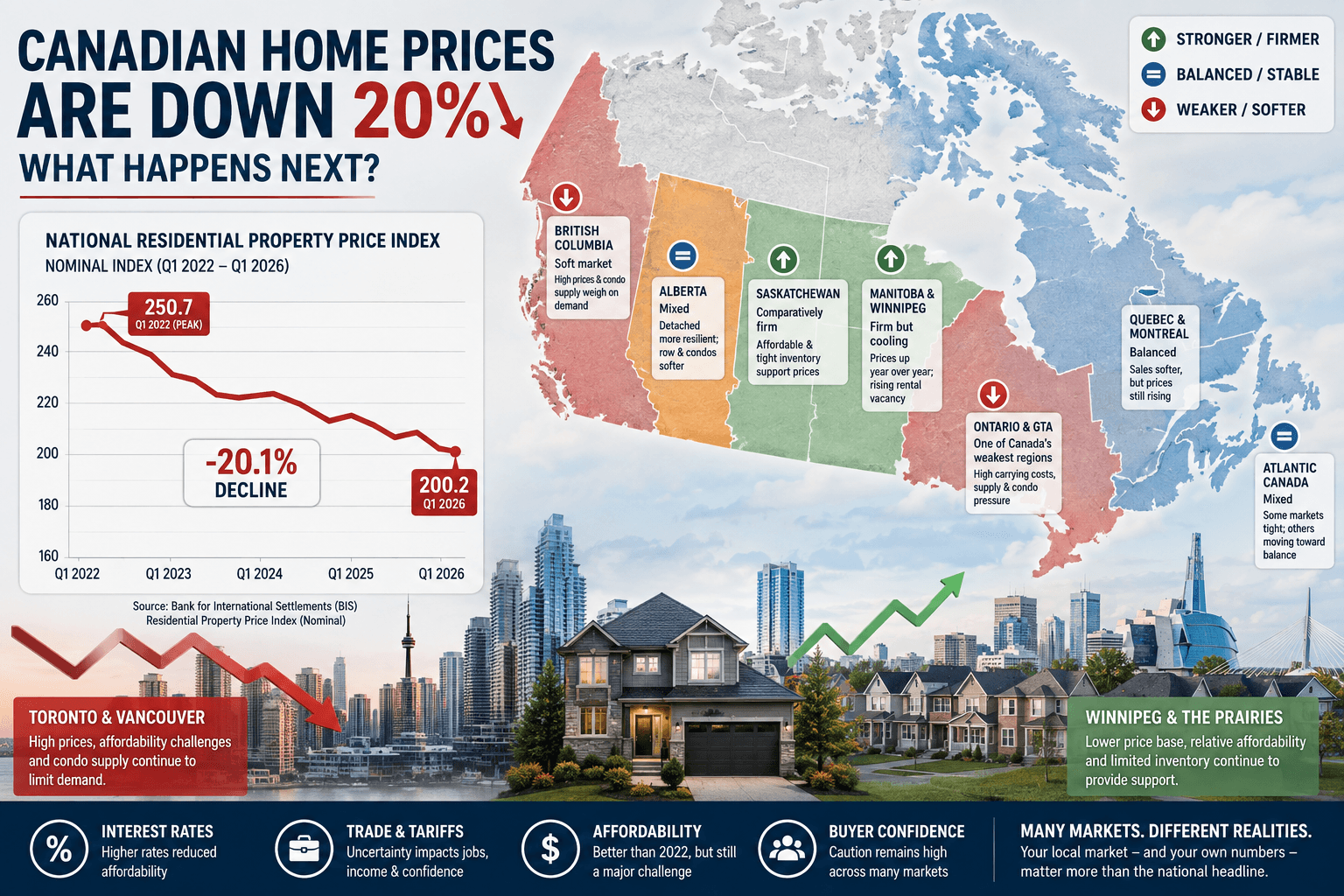
Across Canada, the housing market has entered the spring season with a more cautious tone. According to the Canadian Real Estate Association, national home sales were nearly unchanged in March 2026, with activity still affected by mortgage rates, affordability concerns, and broader economic uncertainty. CREA noted that home sales were down just 0.1% month over month in March, which points to a spring market that is active, but not exactly booming.
Winnipeg, however, continues to tell its own story.
The Winnipeg Regional Real Estate Board reported that the average price for residential detached homes reached $499,434 in April 2026, which was 8% higher than the previous April record set in 2025. At the same time, detached MLS® sales were down 13% compared to last year.
For investors, homeowners, and landlords, that combination matters.
Prices are still strong. Sales have cooled. Buyers are more selective. Mortgage costs are still a major factor. Rental demand remains an important part of the conversation. So, what should property owners do in a market like this?
Should you buy another rental property? Should you hold your current property? Or should you rent out a home instead of selling?
Let’s look at what the spring 2026 Winnipeg real estate market could mean for investors.
Winnipeg Is Not Always the Same as the National Market
One of the biggest mistakes investors can make is looking only at national headlines.
When Canadian housing news talks about the market slowing down, that does not always mean every city is slowing in the same way. Vancouver, Toronto, Calgary, Halifax, Winnipeg, and smaller Manitoba communities all have different price points, buyer behaviour, rental demand, and local economic conditions.
Winnipeg has traditionally been viewed as a more affordable real estate market compared to many larger Canadian cities. That does not mean prices are cheap, especially for first-time buyers, but it does mean Winnipeg can still attract people looking for relative affordability, stable neighbourhoods, and long-term housing options.
For investors, this matters because rental property investment in Winnipeg is often less about chasing rapid appreciation and more about building steady value over time. A single-family home, duplex, triplex, fourplex, or condo can become a long-term asset when it is purchased carefully, maintained properly, and managed professionally.
That is where the current market becomes interesting.
When prices rise but sales slow, it can create uncertainty. Sellers may still expect strong prices. Buyers may hesitate because of mortgage rates. Investors may start wondering whether it is better to wait.
The answer depends on your numbers.
For Buyers: The Deal Has to Work on Paper First
If you are thinking about buying a rental property in Winnipeg in 2026, your first job is not to fall in love with the house. Your first job is to run the numbers.
A property may look attractive, but that does not automatically make it a good rental investment.
Before buying, investors should review:
- Purchase price
- Down payment
- Mortgage payment
- Property taxes
- Insurance
- Utilities, if landlord-paid
- Maintenance costs
- Vacancy allowance
- Property management fees
- Expected rent
- Future repair costs
- Potential renovation needs
Higher borrowing costs can change the entire picture. A property that would have worked well at a lower interest rate may not cash flow the same way today. That does not mean investors should avoid buying, but it does mean every purchase requires more discipline.
A strong rental property should not depend on perfect conditions. It should still make sense if there is a vacancy, a repair, a rent delay, or a higher-than-expected maintenance bill.
This is especially important in Winnipeg, where older housing stock can come with foundation issues, plumbing updates, roof work, insulation concerns, aging windows, and seasonal maintenance needs. A lower purchase price can quickly become less attractive if the property needs major repairs.
Before buying, investors should also consider how easy the property will be to manage. A well-located home with a practical layout, durable finishes, proper parking, and easy maintenance access will usually be easier to rent and maintain than a property that looks good on paper but creates constant tenant or repair issues.
Canopy Mgmt works with residential rental properties throughout Winnipeg, including single-family homes, duplexes, triplexes, fourplexes, and condo units. You can learn more about our local property management services here: Canopy Mgmt Property Management Services.
For Owners: Holding May Be the Smart Move
If you already own a home or rental property in Winnipeg, spring 2026 may be a good time to pause before selling.
That does not mean selling is wrong. Sometimes selling makes sense. You may need the equity, want to reduce stress, or be ready to move into a different investment.
However, when sales activity cools while prices remain high, some owners may be better off holding the property and renting it out, especially if they do not need to sell immediately.
Renting out a home can make sense when:
- The property is in good condition
- The mortgage payment is manageable
- Rental demand in the area is strong
- The owner wants to keep long-term equity
- The property could appreciate over time
- Selling costs would reduce the benefit of listing
- The owner is relocating but not ready to sell
- The home could become part of a long-term investment plan
This is common for homeowners who are moving into a new home but want to keep their original property. It can also be useful for people who inherit a property or who are unsure whether they want to sell in the current market.
The key is not to treat renting as a casual decision. A rental property is a business. It needs proper pricing, tenant screening, documentation, inspections, maintenance, communication, and lease management.
That is where many owners underestimate the workload.
Renting Out a Property Is More Than Finding a Tenant
In a strong rental market, it may feel easy to find someone who wants to move in. But finding a tenant is only one part of the process.
A good rental experience depends on the systems behind it.
Landlords need to think about:
- Advertising the property
- Showing the home
- Screening applicants
- Preparing the lease
- Collecting rent
- Handling deposits correctly
- Managing maintenance requests
- Scheduling repairs
- Completing move-in and move-out inspections
- Communicating with tenants
- Keeping records
- Understanding Manitoba tenancy rules
A poor tenant placement can become expensive very quickly. So can delayed maintenance. Small problems such as a leaking sink, loose railing, clogged eavestrough, or damaged flooring can become much larger problems if they are ignored.
Owners who are used to maintaining a home for themselves may also find that rental maintenance feels different. Tenants may report issues at inconvenient times. Repairs may need to be coordinated quickly. Some problems need documentation. Others need a contractor. In winter, spring, and storm season, the response time matters.
If you are considering turning your home into a rental, Canopy’s team can help with both management and maintenance. View our home maintenance services here: Canopy Mgmt Home Maintenance.
For Sellers: Strong Prices Still Matter
Even with slower sales, the Winnipeg market is not showing weakness in every area. The April 2026 detached average price reported by WRREB was still a record for the month of April.
For some owners, that may make selling attractive.
Selling can make sense if:
- You want to access equity
- The property needs major repairs
- The home does not work well as a rental
- You do not want landlord responsibilities
- The property is in an area with weaker rental demand
- You can reinvest the money into a better opportunity
- You are reducing debt or simplifying your portfolio
The important thing is to compare selling against renting, not just emotionally, but financially.
Ask yourself:
What would I likely net after real estate commissions, legal fees, mortgage payout costs, and moving expenses?
Then compare that with the long-term rental potential.
What rent could the property achieve? What would the monthly expenses be? What repairs are needed before renting? What would the property be worth in five or ten years? Would professional management make the investment more passive?
There is no one-size-fits-all answer. A property that should be sold by one owner may be worth keeping for another.
What Investors Should Watch in 2026
The rest of 2026 will likely continue to be shaped by affordability, borrowing costs, inventory levels, rental demand, and buyer confidence.
For Winnipeg investors, here are a few things to watch:
1. Mortgage Rates
Even small changes in rates can affect buyer activity and investor cash flow. Higher rates can reduce purchasing power, but they can also keep more people renting longer.
2. Local Inventory
If more homes become available, buyers may have more negotiating power. If supply stays tight in certain neighbourhoods, prices may remain firm.
3. Rental Demand
Investors should pay attention to how quickly quality rentals are leasing, what tenants are looking for, and which neighbourhoods are seeing stronger demand.
4. Maintenance Costs
Contractor costs, materials, and emergency repairs can affect returns. Investors should budget realistically instead of assuming maintenance will be minimal.
5. Property Type
Single-family homes, condos, duplexes, triplexes, and fourplexes all behave differently. Multi-unit properties may offer more income potential, but they can also require more management.
The Bottom Line for Winnipeg Investors
The Winnipeg real estate market in 2026 is not a simple “buy everything” or “wait it out” market.
It is a numbers market.
If a property makes sense after realistic expenses, proper maintenance planning, and conservative rent estimates, it may still be a good investment. If the numbers are too tight, waiting or improving an existing property may be smarter.
For current owners, renting out a property instead of selling could be a strong option, especially if the property is in good condition and located in a desirable rental area. But it should be done properly.
At Canopy Mgmt, we help Winnipeg property owners manage their investments with practical systems, tenant support, maintenance coordination, and local experience. Whether you own one home or several rental properties, the goal is simple: protect the property, support the tenant, and help the investment perform over time.
Learn more about our services here: Property Management in Winnipeg.